CoreWeave grew revenue by more than $1 billion in three months and told investors it can fund the next leg of its buildout without returning to the unsecured bond market at today’s rates.
Third-quarter revenue rose 168% to $3.66 billion, and CoreWeave raised its full-year revenue forecast to $13.0 billion to $13.3 billion. The report landed after the stock had lost more than 40% of its value over the prior month as investors rotated out of AI infrastructure names and some CoreWeave bond yields topped 16%, CNBC reported. The shares were up 10.8% in premarket trading Wednesday as of 5:08 a.m. ET, according to CNBC, with Nebius, Applied Digital and Iren also higher.
Revenue beat the $3.55 billion analysts expected, based on LSEG consensus, and the adjusted loss of 95 cents a share was narrower than the $1.16 forecast. The GAAP net loss widened to $709 million from $110 million a year earlier, and net interest expense climbed to $846 million from $310 million. Operating income was $207 million, up from $52 million.
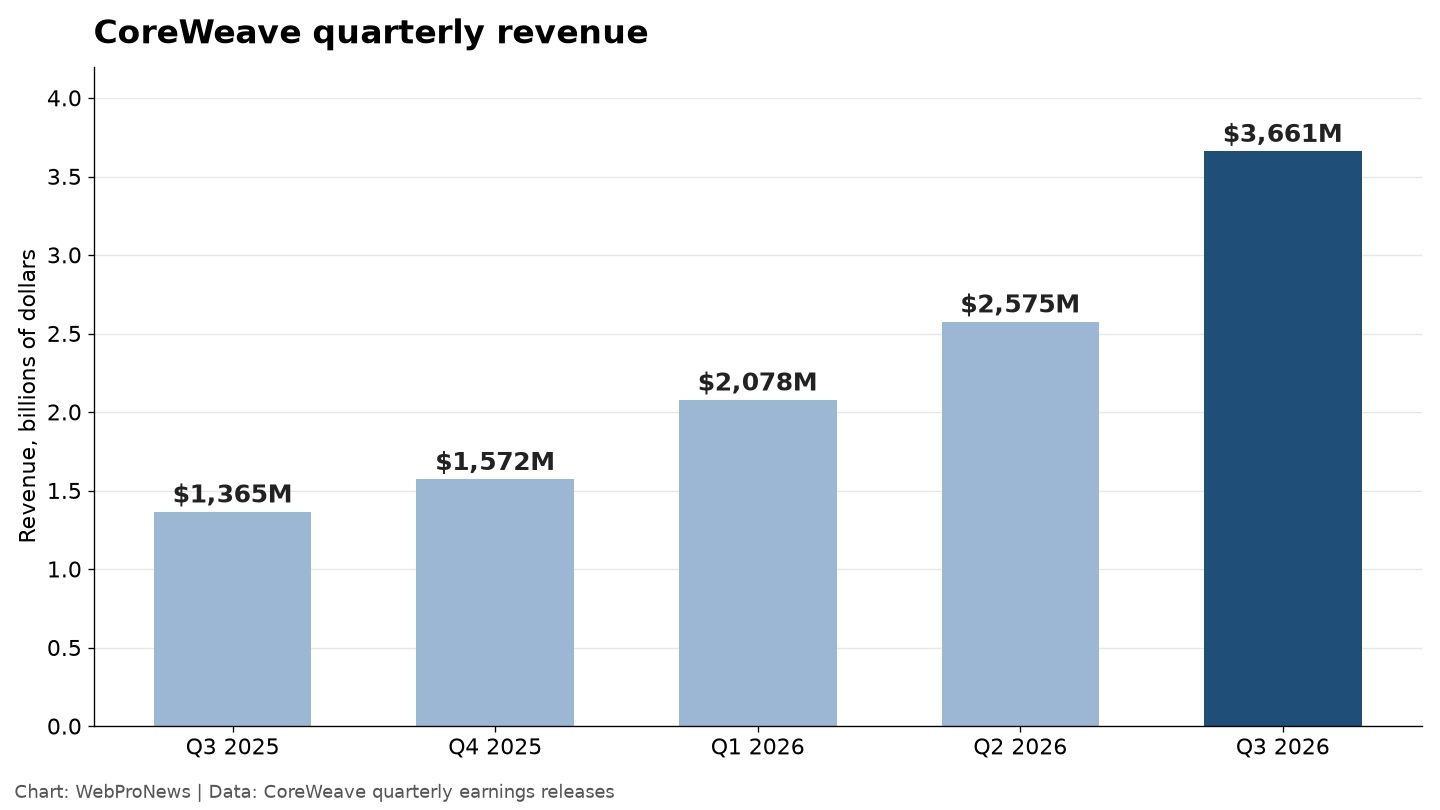
“This was a breakout quarter for CoreWeave, with revenue increasing by more than $1 billion sequentially and adjusted operating margins reaching double digits a quarter ahead of plan,” said Michael Intrator, the company’s co-founder, chairman and chief executive. Adjusted operating income was $379 million, a 10% margin. CoreWeave now expects full-year adjusted operating income of $1.275 billion to $1.375 billion, 26% higher at the midpoint than its prior guidance of $960 million to $1.15 billion. Analysts surveyed by Visible Alpha had been looking for $1.07 billion. The company also lifted its target for annualized run-rate revenue at the end of the year to $20 billion to $21 billion.
Paying for the buildout
CoreWeave also laid out how it will pay for the buildout. “At current yields, we do not intend to issue additional parent-level unsecured debt through 2027,” Nitin Agrawal, the finance chief, told analysts on the conference call. “By contrast, the asset-level secured debt market has remained stable, with our loans continuing to trade around par value.” He projected less than $5 billion in incremental parent-level capital through 2027, and said CoreWeave plans to raise new debt tied to a set of contracts in the coming weeks.
Intrator said most of the capital needed through 2027 will come from delayed-draw loans tied to customer contracts, customer prepayments and financing from hardware partners, with only “a limited amount” expected to be raised at the parent company level. The company said it expects about $9 billion in customer prepayments and deposits over the next three months. During the quarter it sold about $4.2 billion of convertible senior notes in an upsized offering, set up its first at-the-market equity program for up to 35 million Class A shares and closed its $2.6 billion DDTL 5.5 facility, its first built for shorter-duration customer contracts. The shift comes as lenders have grown wary of AI-only borrowers, a pullback WebProNews tracked last month.
Today we announced our Q3 earnings:
$379M adjusted operating income, well above guidance
1.7GW+ of active power, doubling our active footprint YTD— CoreWeave (@CoreWeave) November 10, 2026
Post: CoreWeave on X
Demand kept building. Revenue backlog reached about $132.5 billion at the end of September, up from roughly $104 billion at the end of June. CoreWeave added more than 200 megawatts of active power in the quarter to reach over 1.7 gigawatts, double its footprint at the start of the year, and grew contracted power by more than 900 megawatts to over 4.6 gigawatts. Its international footprint passed 1.3 gigawatts of contracted power, including India, Indonesia and Spain. New customers include Canva, Substack and Wayve, and the company expanded work with OpenAI, Perplexity, Jane Street and Cohere. Its first production workloads on Nvidia’s Vera Rubin NVL72 racks, run for Cognition, delivered 4.8 times the token throughput of GB200 NVL72 systems, the company said.
Spending is rising to match. CoreWeave now expects 2026 capital expenditures of $37 billion to $39 billion, lifting the low end of its earlier $35 billion to $39 billion range because it expects to deliver infrastructure to customers sooner than planned. It still targets more than 1.85 gigawatts of active power by year-end, and guided fourth-quarter interest expense to $1.05 billion to $1.15 billion.
Anthropic, a key customer, is scheduled to debut on the Nasdaq next week after setting its IPO range. “We see that we’re going to have long-term relationships with the AI labs,” Intrator said. Agrawal tied next year’s spending to contracts already signed: “Should we choose to focus only on our committed backlog, we would expect capex for 2027 to remain in line with our 2026 capex investment, while revenue and EBITDA grow significantly.”
The next read on the neocloud trade comes Thursday, when Nebius, whose shares had fallen by a similar amount, reports its results.